Friday, July 27, 2007

Slax 6.0 RC6 - The Linux O.S which runs from the CD


Slax is the the Linux operating system which runs directly from the CD or USB without installing. Slax fits on a small disc. Slax 6 RC6 includes Linux Kernel 2.6.21.5 and KDE 3.5.7. Slax 6 RC6 is based on Slackware 12.0 Linux distribution and uses Unification File System. Below is the screenshot of Slax.


After downloading Slax6RC6.iso from ftp site, then you have to burn it to a CD. Start your CD writing software and search for Burn image or Burn CD iso image option. Then burn the iso image to a CD using the Burn image option. The CD works only if you select Burn image or Burn CD iso image option.

The computer boots from Slax CD in three different ways. First one depends on type of motherboard. While booting your system from Slax CD, press a special key F11 or F2 or F10. Many motherboards support this method. Second method is, you have to set CDROM as first boot device in BIOS SETUP. Third way is by starting DOS and using linux.bat program from SLAX CD.

Download Slax 6.0 RC6

You can download Slax old and new versions from here.


Download Visual Studio 2008 Beta 2


Microsoft announced Visual Studio 2008 Beta 2 version. Visual Studio 2008 is the next generation development tool for Windows Vista, office 2007, and the Web. Visual Studio 2008 provides tools that speed creation of software and services on the latest platforms, including the Web, Windows Vista, Office 2007, SQL Server 2008, and Windows Server 2008. Visual Studio 2008 enables the developers to solve complex business problems at low cost. The developers can develop quality software with the new Tools of Visual Studio 2008. Developers can improve their skills and work with Visual Studio 2008.

All versions of Visual Studio 2008 beta 2 will be available at the following Microsoft site. Also you can download latest Microsoft.NET Framework 3.5 Beta 2 from the same location.

Download Visual Studio 2008 Beta 2


Thursday, July 26, 2007

Shup v0.14 - Free Screen capture Utility


Shup is a free Program which captures your desktop and uploads files to many different hosts. Shup also includes a built in Image Editor. You can share your screenshots, images, and other files by turning them into web links with this small utility program Shup. Shup supports Windows 2000, Windows XP, and Windows Vista.

How to Use Shup?
When you run Shup program then Shup Icon will sit in system tray. If you want to take a screenshot of your desktop or the currently active window, then right click on the Shup icon at the system tray, then select Capture Desktop. Wait for sometime. Shup will take the screenshot of the desktop or active window and store it in default directory C:\Program Files\Shup\Archive. The image is saved in PNG format only. Also the image is automatically uploaded to any one of the supported hosts like ImageShack, Stasbox etc. Also the URL is placed into your clipboard so that you can easily copy and share that image url with your friends.

See the screenshot below, taken by Shup


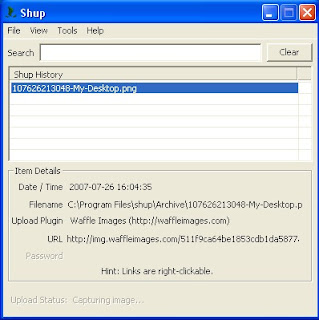
You can also get the URL details in another way. Just doubleclick on Shup icon at the system tray. Then Shup history window will open. Just click an item in history window. Then Shup will display the item details as shown in the figure below.


You can upload files to different hosts like Flickr, ImageShack, PhotoBucket, Stashbox, and Waffle Images with Shup. Just right click the file you want to upload then select Shup, then select the host. It is very simple process.

You can do Image editing also with Shup. Just right click the image you want to edit then select Shup, then select Open In Shup. Now Shup will open the image. Remember Shup supports only PNG format. Shup provides Paint Brush Tool, Highlighter Tool, Rectangular selection Tool and Crop Tool. You can do Image editing with these Tools.

Download Shup


Wednesday, July 25, 2007

Process Monitor v 1.2


Process Monitor is an advanced monitoring tool for Windows. It shows real-time file system, Registry and process/thread activity. Process Monitor's user interface and options are similar to those of Filemon and Regmon. But Process Monitor includes numerous significant enhancements over Filemon and Regmon.

Process Monitor displays file system activity for all Windows file systems, including local storage and remote file systems. Process Monitor automatically detects the arrival of new file system devices and monitors them. To remove file system operations from the display de-select the file system push-button in the Process Monitor toolbar and to add back file system operations depress the button.

Process Monitor logs all Registry operations and displays Registry paths. To remove Registry operations from the display de-select the Registry push-button in the Process Monitor toolbar and to add back Registry operations depress the button.

In its process/thread monitoring subsystem Process Monitor tracks all process and thread creation and exit operations as well as DLL and device driver load operations. To remove Process operations from the display de-select the process push-button in the Process Monitor toolbar and to add back process operations depress the button.

Process Monitor supports Windows 2000 SP4 with Update Rollup 1, Windows XP SP2, Windows Server 2003 SP1, and Windows Vista. Also supports 64 bit versions of Windows XP, Windows Server 2003 and Windows Vista.

Download Process Monitor


How to rectify DLL Errors like MSVCR71.dll was not found or MSVCP71.dll was not found or any dll was not found?


Have you received the following DLL error messages when try to install a program?

The application has failed to start because MSVCR71.dll was not found.

The application has failed to start because MSVCP71.dll was not found.

The application has failed to start because xxx.dll was not found.

I think everyone has received this type of messages. We can rectify this type of messages very easily.

First I will explain what is a DLL file and it's uses. Then I will give the solution to the above type of dll error messages.

A dynamic-link library (DLL) is a module that contain functions and data that can be used by another module. Module can be another DLL or a Windows application. A DLL can be used by several programs at the same time. Windows operating system provides some DLLs. Some DLLs are particularly written for a application and these DLLs are loaded with that particular application.

DLLs save memory, reduce swapping, save disk space, upgrade easier, provide after-market support, provide a mechanism to extend the MFC library classes, support multilanguage programs, and ease the creation of international versions. DLL file will be loaded in to RAM when a program needs it only. Thus DLLs save memory. It saves Disk space since same DLL is used by several applications. If each application has it's own DLL then a lot of space is required.

Rectification of DLL Errors:

If you get the application has failed to start because MSVCR71.dll was not found error message, then you have to download MSVCR71.dll zip file. Then extract it. Then copy MSVCR71.dll file and paste it in Windows/System directory.

Download MSVCR71.dll

If you get the application has failed to start because MSVCP71.dll was not found error message, then you have to download MSVCP71.dll zip file. Then extract it. Then copy MSVCP71.dll file and paste it in Windows/System directory.

Download MSVCP71.dll

Other DLL Errors:
If you get any other dll errors then just goto the above site http://www.dll-files.com. In that site you will find Search for DLL Files. Just type the DLL you want in the box, then click O.K. Now it will display that DLL informaton. On the same page you will find the download link for that DLL file. After downloading the DLL file paste it in Windows/System directory.